
Food Insecurity in MoCo and the Food as Medicine Grant
Did you know that approximately 30% of Montgomery County residents experience food insecurity? According to a report from the Capitol Area Food Bank in 2022, many families are struggling to get food on the table. SNAP benefits are being cut, with more potential reductions to come in the House Agriculture Committee's farm bill proposal. We are doing something very wrong when our communities are going hungry and having to pinch pennies to make the next meal happen.

Organizations like Manna Food Center and other local food banks are doing the best they can with limited funds. Manna alone served upwards of 50,000 participants and distributed 4.6 million pounds of food in FY 2023. They estimate that 3 in 10 people in MoCo are experiencing food insecurity and 20% of seniors are living below the self-sufficiency standard.
What is the Self Sufficiency Standard you may ask? Well up until writing this blog post I had never heard of the term either! Coming from the Center for Women's Welfare at the University of Washington, it is a "budget-based, living wage measure that defines the real cost of living for working families at a minimally adequate level." It defines the amount of income necessary to meet basic needs without public subsidies or formal/informal assistance.
The state of Maryland now has this great tool, the Self Sufficiency Standard Calculator, into which you can input family size and county to determine the Self Sufficiency Standard number for your unique experience.
Coming back to the specifics of food insecurity in Montgomery County, a self sufficiency wage for a family of 2 adults and 2 school-age children, in MoCo, would be $111,536. However, seeing the data from Manna and other similar organizations, it is clear that many families in the county are well below that number. Federal programs like SNAP can help, but with an income threshold of 130% of the federal poverty level, just below $30,000, and the high self sufficiency standard in the county, many families are stuck in between. Making too much to be eligible for SNAP but still way below the self sufficiency standard.
The Office of Food Systems Resilience, part of Montgomery County government, started a new grant program this year to help address this problem. The Food as Medicine grant program was awarded to 5 different partnerships, all working to source local, fresh food for families facing food insecurity. Pediatric healthcare providers screen patients for food insecurity and then connect the families with the program to provide them weekly food distributions.
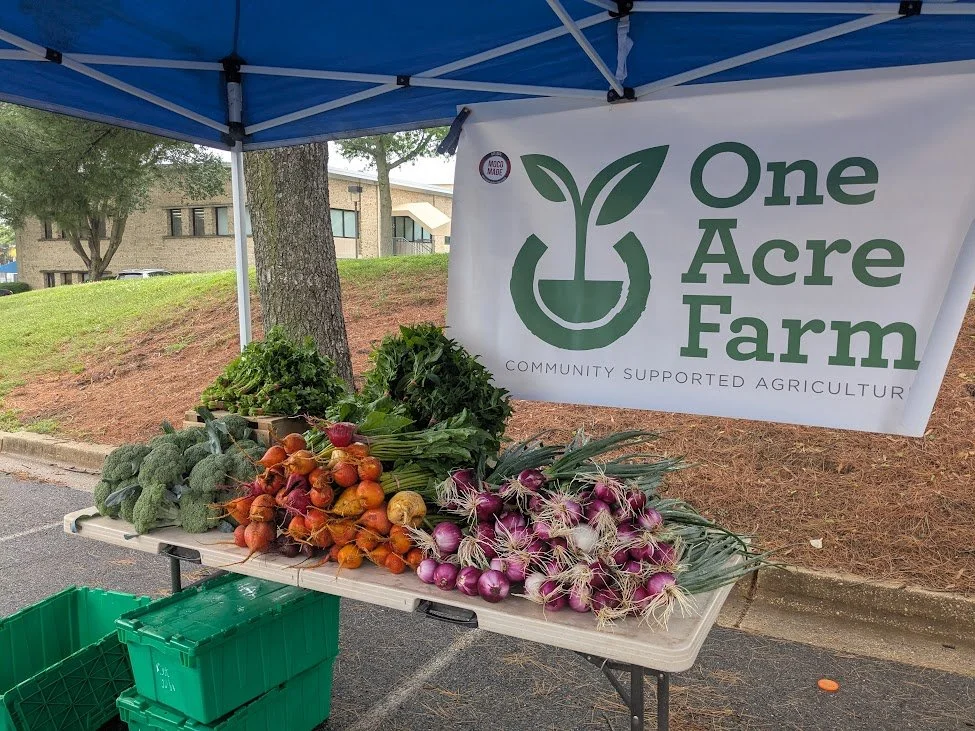
We partnered with Adventist HealthCare to apply for this grant and have been packing up vegetables and distributing them on a weekly basis for several months now. After initially packing bags on a weekly basis for our first year with this grant, we have since switched to a market-style model. So in 2025 we brought a variety of vegetables in bulk to two different locations a week and displayed them on tables like you would see at a farmers market. Then the families would arrive, select what they wanted so it added up to the amount allotted per family, and then headed home with fresh produce.
It has been a great learning experience curating the vegetable selection throughout the seasons and tailoring it to the specific community with whom we are working. It is a majority Latino community so we do our best to adjust the bag contents to be culturally relevant and appropriate for families with young kids.
This is what our weekly bag counts look like on top of these market-style distributions:
160 CSA bags
200 Hospital employee-benefit program bags
200 (once a month) KITE Realty bags
$1700-$2000 worth of vegetables, two days a week for Food as Medicine
It requires quite a bit of planning and organization on our end to make sure that we're picking the right quantities of everything and that they all end up in the right places!
But if our participation in this program is helping 60-100 families worry a bit less about where the next meal is going to come from, then we welcome the complexity. We know it's a small step in the right direction however, the problem is a big one that local grants can't, and shouldn't, be the only solution. We need more federal money and support to effectively end food insecurity. Because that needs to be the true goal, not just reducing food insecurity. No one should go hungry, especially when 30-40% of food supply is wasted each year in this country.
