
Why do farmers plant cover crops?
- One Acre Farm
- Sep 25, 2025
- 4 min read
How to start a blog post about cover crops? On the surface, it doesn’t seem like the most engaging topic to read about. More like you’re back in school, taking an agricultural science class! Unless you went to school for agricultural science, in which case this would be right in your wheelhouse!
Now, I didn’t go to school for agriculture, and neither did Farmer Mike. We both ended up in this field through a series of choices and cosmic tilts. That means that we’ve learned what we know about agriculture, the science of it, the practicalities, and the magic, from quite literally learning on the job. Through trial and error, big mistakes and small wins, and crucially, from the guidance and wisdom of other farmers who have been generous with their knowledge.

What we’ve learned about farming over the years covers a wide range of topics, so today we’ll just focus on cover crops. At its most basic, this is a technique used to protect the soil during a field’s rest period by reducing erosion and improving soil health. We like to give our fields time to rest in between vegetable crop plantings so that we don’t plunder the resources that the soil has to offer. If you keep planting crops that take and take, season after season, the soil will run out of nutrients, and the quality of your product will decrease.
By planting a specific mix of grasses and legumes, we can ensure that the soil will be rejuvenated and ready for the next planting of vegetable crops. How do we know this? Well, lots of brilliant soil scientists and botanists have done the work to find out what certain plants do to build up the health of the soil, and the larger ecosystem. And we are lucky enough to benefit from that research and knowledge!

For example, the current cover crop seed mix that we are using and seeing grow in several fields right now includes cowpeas, buckwheat, sunn hemp, and sorghum sudangrass. Each of these crops has their own job:
Cowpeas are in the legume family and thus are great nitrogen fixers. This means that they take gaseous nitrogen from the air, where it is plentiful, and fix it into organic nitrogen that will then be added to the soil when the plants decompose. Nitrogen is a nutrient crucial to photosynthesis and other aspects of plant growth and health.
Buckwheat actually isn’t in the wheat family, as its name would suggest, instead it’s part of the knotweed family. It is a fast grower and flowers prolifically, which attracts all sorts of beneficial insects and pollinators. The honey produced on our farm often has a darker color and richer flavor due to all the pollen that the bees collect from the flowering buckwheat! Since it grows rapidly, it also acts as a weed suppressor, which is a wonderful feature to make our lives easier in the future!
Sunn hemp is another legume, so it also aids in nitrogen fixation like the cowpeas. The more the merrier! Additionally, it has an extensive taproot which helps to break up the soil and reduce compaction. It also has some gorgeous yellow flowers which attract more pollinators.
Sorghum sudangrass is a great biomass producer. Biomass is not a simple thing to explain, so suffice it so say that the more biomass, the better! Similar to sunn hemp, sorghum sudangrass also helps to aerate the subsoil with deep roots.
Clockwise from top-left: cowpeas, buckwheat, sorghum sudangrass, and sunn hemp.

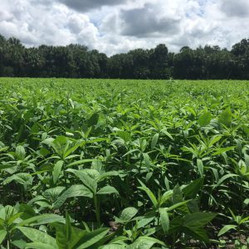


Now the one aspect to cover cropping that can be a hold-up for some people is that those fields are “out of commission” for a while. We are lucky to have enough fields that we can rotate around where we plant our crops (which is a whole other discussion) and thus build cover cropping into that rotation. However, even just employing cover crops during the winter months when you’re not planting production crops will be beneficial. Not least to reduce soil erosion when the heavy spring rains come along!

So, from an academic perspective, I hope this has been interesting! I definitely learned some new things along the way researching for this blog. If you’d like to put some of this into practice, but don’t own a farm, cover crops can be used in gardens too! Any plot of soil you grow in can benefit from this practice. A combo of species is always recommended, as they each have different benefits.
For a fall planting (you still have time!) you could use winter wheat and crimson clover as a seed mix, the latter being a legume. These will likely die off over the winter leaving your garden ready to plant early spring veggies. In the spring you’ll want to leave about 2 weeks for the plants to break down and then you can plant into the “mat” of dead vegetation (which will act as a natural mulch) or turn them under before seeding your vegetables. Another option is daikon radishes, which are great for breaking up compact soil. They are easy to grow and are also edible!

Now, quiz time! Why DO farmers plant cover crops? Just kidding! The benefits of cover cropping are myriad, but foremost it helps with controlling erosion, increasing nutrient content in the soil, and attracting pollinators. And, if you come to our Fall Farm Party/Tour/Open House on October 4th, you'll get to see our beautiful cover crop up close and in person!
~Sophia